Installation · Repair · Replacement
Roofing done once, properly.
A roof fails at its details long before it fails at its field. We build the details — valleys, penetrations, edges and ventilation — to outlast the shingle.
The honest version
Most roofs don't wear out. They leak at something that was never flashed.
Shingles are the cheapest part of a roof and the only part most people shop on. The parts that determine whether you are back up there in eight years are the ones you cannot see from the driveway.
Step flashing at wall intersections. Ice-and-water membrane in the valleys and at the eaves, which matters in a Maryland freeze-thaw winter. A deck that has been walked and inspected rather than shingled straight over. And balanced intake and exhaust ventilation — without it, the attic cooks the shingles from below and voids the manufacturer's warranty you paid for.
We quote all of it explicitly. If a competing bid is significantly cheaper, ask them which of those four items are in their price. Usually that is the whole difference.
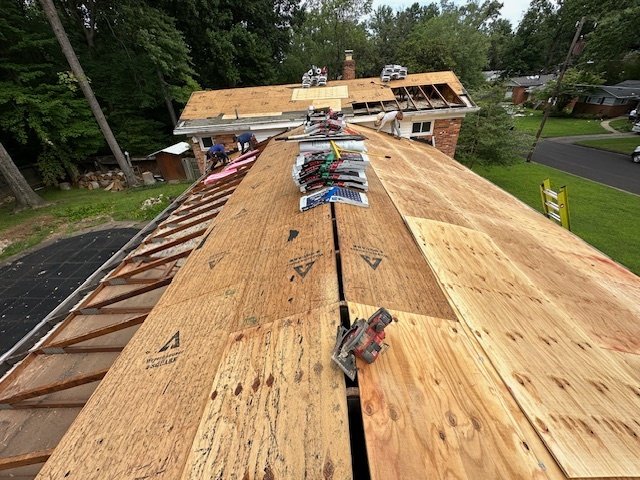
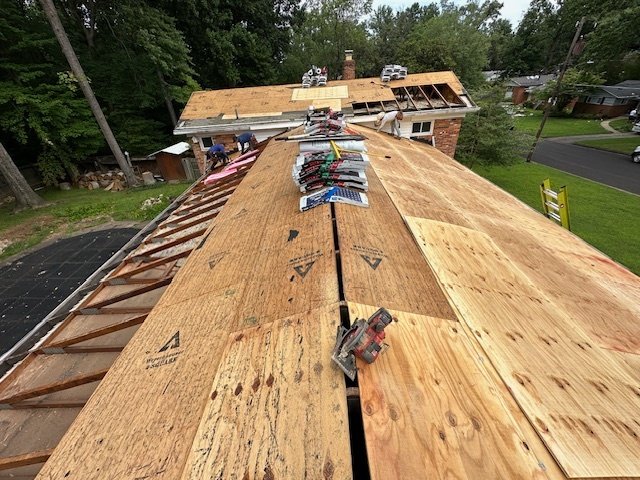 Tear-off & deck inspection
 Valley & flashing detail
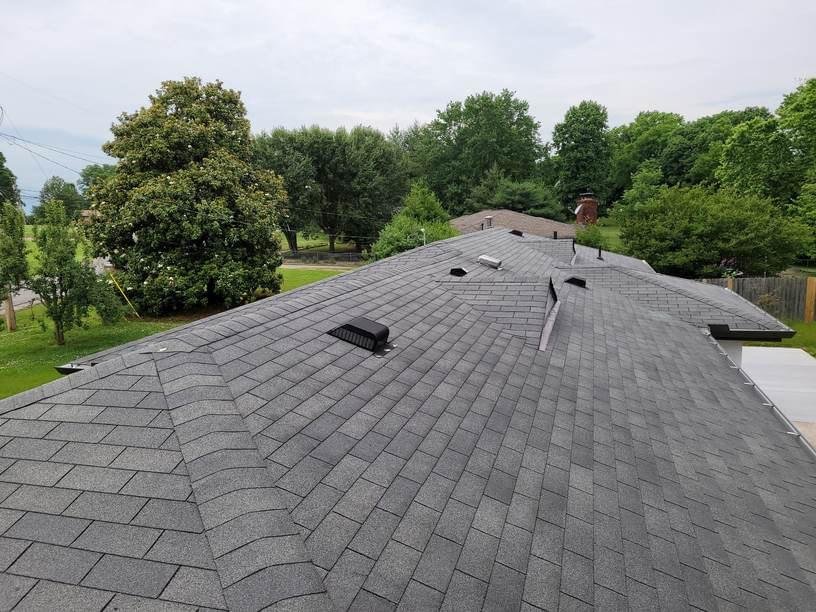
 Ridge ventilation
Systems we install
The right system is a function of your roof, not our preference.
Pitch, exposure, structure and how long you intend to stay all change the correct answer. Here is how we think about it.
Architectural asphalt shingle
The default for most Maryland homes, and for good reason: strong wind ratings, a wide colour range, and a cost-per-year that is difficult to beat. Laminated architectural shingles carry substantially better wind and impact performance than the old three-tab profile, which we no longer install on full replacements.
We install as a complete system — underlayment, ice-and-water shield, starter course, field shingle, hip and ridge cap and ventilation from a single manufacturer — because mixing components is the most common way a manufacturer declines a warranty claim.
Standing seam metal
Concealed-fastener panels with no exposed screws to back out and leak in fifteen years. Roughly twice the upfront cost of shingle and roughly twice the life, so the economics only work if you are staying — or if the roof is highly visible and the look is the point.
It also performs well on low pitches where shingle cannot go, sheds snow cleanly, and pairs naturally with solar because panels can be clamped to the seams without a single roof penetration.
Low-slope and flat systems
Porch roofs, rear additions and dormers frequently sit below the pitch a shingle can handle. Shingling them anyway is one of the most common defects we are called to fix — water does not run off fast enough, it wicks back under the courses, and the ceiling below stains within two winters.
The correct answer is a fully-adhered or mechanically-fastened single-ply membrane, heat-welded at the seams and properly terminated where it meets the wall above.
Repairs and storm damage
Not every roof needs replacing, and we will say so. If you have a discrete leak, missing shingles after a wind event or damaged flashing, a repair is often the right call — particularly if the roof has meaningful life left.
What we will not do is sell you a repair on a roof that is genuinely finished, or a replacement on a roof that has ten good years in it. You get our honest read either way, in writing, along with photographs of what we found.
The estimate
Paid, written, and yours to compare.
We charge a flat fee for a roofing estimate. That is unusual, and it is deliberate.
A free estimate is never free — it is recovered in the price of the job, and it buys the contractor the right to sit in your living room for four hours. We would rather charge a transparent fee, do a proper measured takeoff, and hand you a document you can take to any other contractor. It also means we have no incentive to inflate the scope to justify the visit.
Replacement day
What actually happens to your house.
Most full replacements are a one to three day job. Here is the sequence, so nothing on the day is a surprise.
Protect
Tarps over landscaping, plywood against siding and windows, and vehicles moved clear. Debris is dropped to a defined zone, not the whole garden.
Tear off & inspect
Down to bare deck. Every sheet is checked for rot and soft spots — replacement decking is quoted at a per-sheet rate agreed in advance, so nobody invents a number mid-job.
Dry-in & detail
Ice-and-water shield at eaves and valleys, synthetic underlayment across the field, then drip edge, step flashing and every penetration re-flashed rather than re-caulked.
Finish & sweep
Field shingle, hip and ridge cap, ridge vent. Then a full magnetic sweep of the grounds for nails — twice — and a walk-round with you before we leave.
Roofing questions
The ones we get asked most.
Age is the first filter — an asphalt roof past about twenty-two years is usually spending money badly on repairs. After that it is about pattern: a single leak at one penetration is a repair; granule loss across the whole south face, curling edges, or multiple leaks in different planes means the field itself is finished. We photograph what we find and tell you which it is, in writing.
Code generally permits one overlay, and it is cheaper. We rarely recommend it. You cannot inspect the deck, you cannot correct flashing properly, the assembly runs hotter and therefore shorter, and the next roofer inherits a double tear-off. If budget is the constraint, say so — there are better places to save.
Yes. For storm damage we document the condition thoroughly with dated photographs and provide an itemised scope your adjuster can work from. Note that we are contractors, not public adjusters — we will not negotiate your claim on your behalf or advise you to misrepresent damage, and we would be cautious of anyone offering to.
Two separate things, and it matters to keep them separate. The manufacturer warrants the materials — length and terms depend on the system specified and on installing it as a complete system. We warrant the workmanship, which covers installation defects. Both are stated on your estimate before you sign, not described verbally.
A typical single-family tear-off and re-roof is one to three working days depending on size, pitch, number of layers coming off and complexity of the roofline. Weather can move it — we will not dry-in a roof we cannot close the same day, and we will always tell you the day before rather than the morning of.
Worth doing together
While we have access at height.
Siding
One mobilisation, one set of access equipment, and the roof-to-wall flashing tied together properly rather than patched into existing work.
Siding services Pairs withPorch roofs
Porch and addition roofs are usually low-slope and usually the first thing to leak. Worth correcting while the main roof is open.
Decks & porches Start hereWritten estimate
Measured takeoff and itemised cost breakdown in two to five business days. Rush option available.
Request an estimateRoofing
Get a number you can actually rely on.
Measured takeoff, itemised breakdown, warranties stated. Two to five business days.